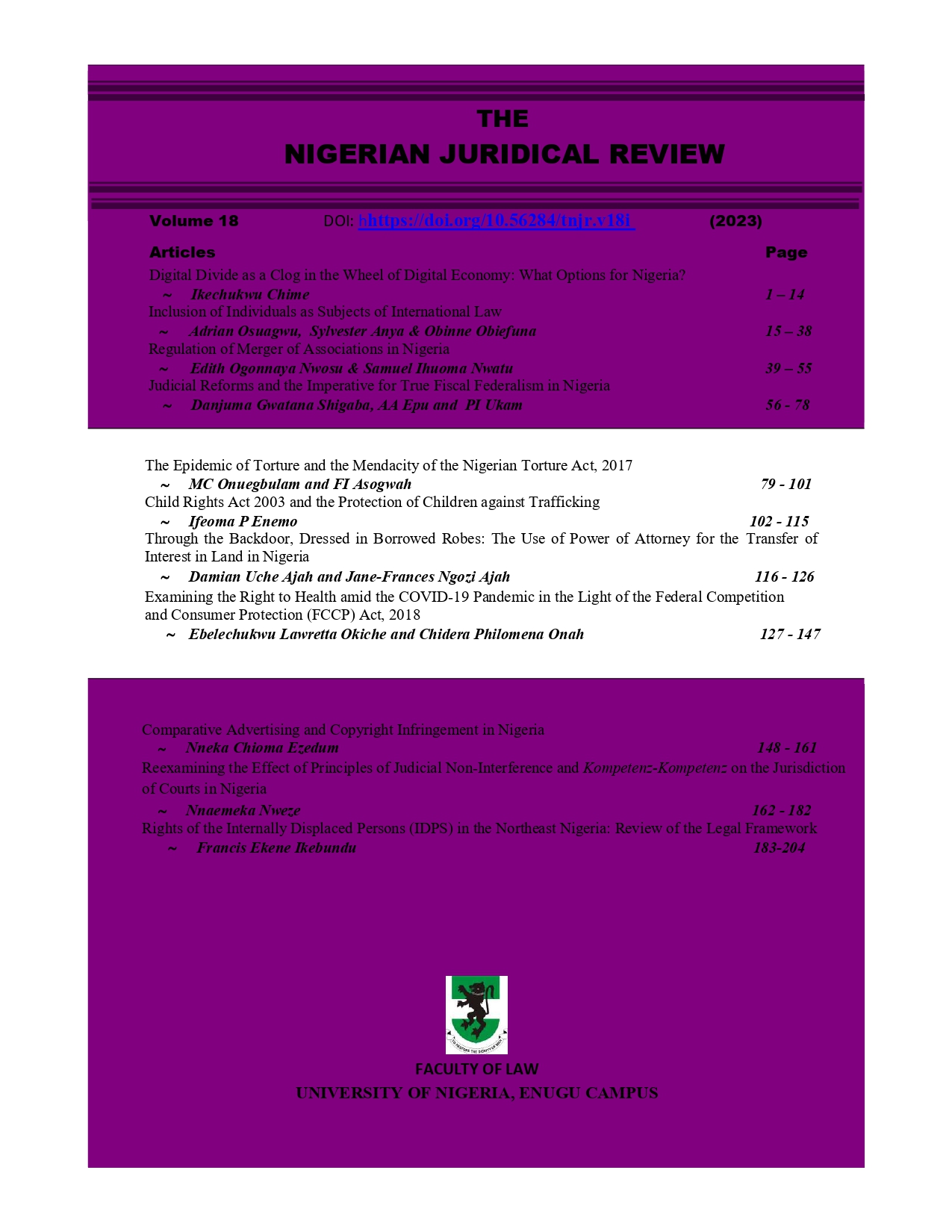
Rights of the Internally Displaced Persons (IDPs) in the Northeast Nigeria: Review of the Legal Framework
DOI:
https://doi.org/10.56284/47yt4512Keywords:
Insurgency, Human Rights, Internally Displaced Persons, Northeast Nigeria, International and Regional Frameworks on the Rights of Internally Displaced PersonsAbstract
Boko Haram insurgency has given Nigeria a chequered history of the incidence of internally displaced persons (IDPs). The 2014 United Nations report on the population of IDPs across the globe stands at 60,000,000, of which 2,100,000 are estimated to have been displaced by the menace of the Boko Haram insurgency in Northeast Nigeria. The violent attacks and deliberate destruction of homes and properties in the Northeast Nigeria gave birth to the saga of IDPs in the country. The IDPs, being persons with special status as a result of their displacements from their usual abodes, shifted attention to the peculiarity of the rights available for their circumstances apart from the generally guaranteed fundamental human rights. Several reports had it that the same IDPs have been subjected to a series of abuses in the form of violations of their rights. This thus prompted this paper to investigate the rights of the IDPs from the available legal framework. The paper, while adopting the doctrinal method of legal research and study, examines the adequacy or otherwise of the available legal framework for the rights of the IDPs from the international stage through the regional stage and down to what is nationally obtainable in Nigeria as a country. The paper exposes the relevant challenges and inadequacies in the legal framework amidst a lack of full-fledged domesticated laws on IDPs’ rights in the country. The paper found that the biggest challenge to the implementation of IDPs’ rights in Nigeria lies in the lack of a robust legislation to specifically cater for the IDPs. The paper thus recommends domestication and religious implementation of the relevant international and regional instruments on IDPs’ rights by the Nigerian government.